
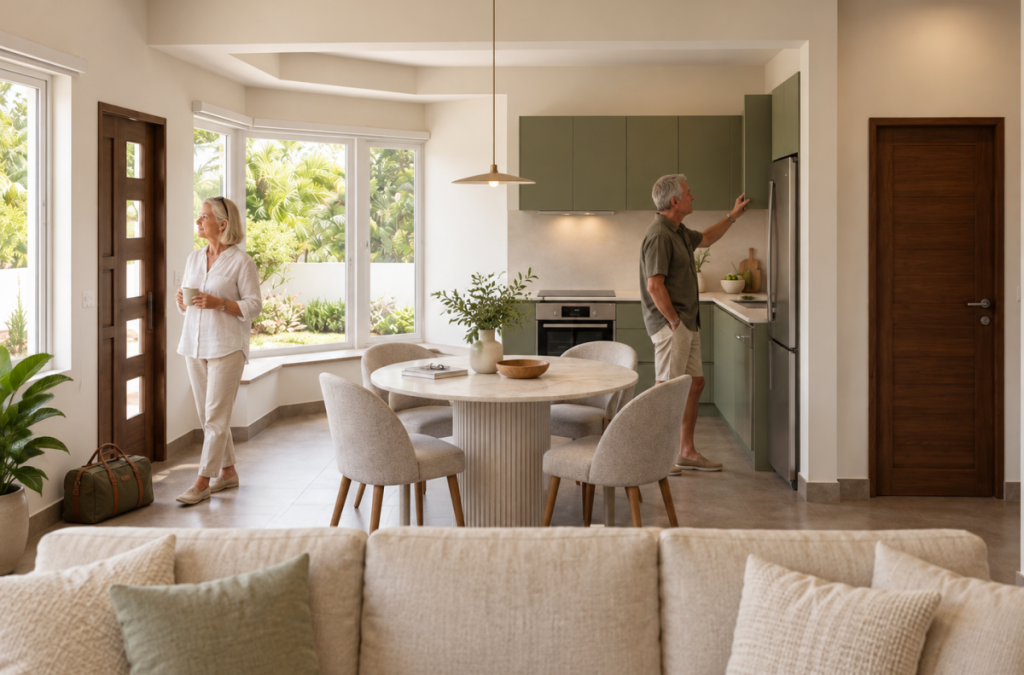
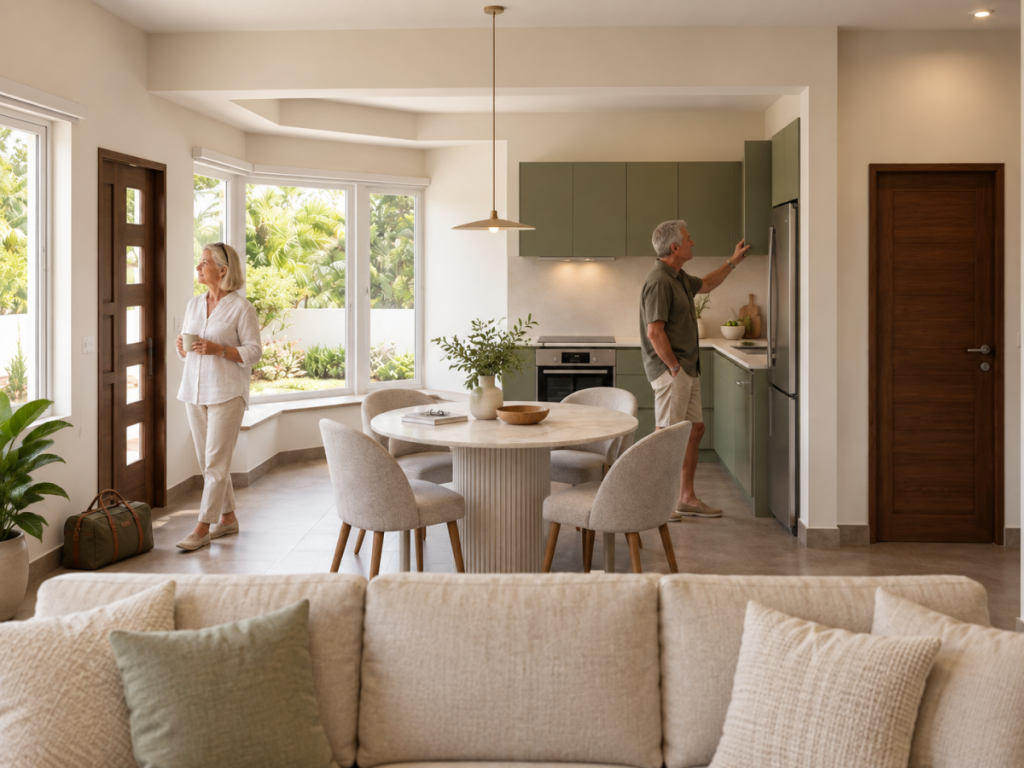
Test the same home twice: once for the months you expect to spend in Thailand now, and again for the possibility that you may live there much longer later.
A retirement home near Hua Hin can look right on a property list and still be wrong for the way you plan to use it. The issue is not simply whether you like the layout. A home used for six months each year is asked to do a different job from a home that becomes your main twelve-month base. The useful question is whether the same home can support the year you actually expect to live.
Test 1: Put your calendar before the floor plan
Before comparing bedrooms, plot size, terraces or pools, sketch the year first. Which months are likely to be in Thailand? Will you return to another country for part of the year? How often will family visit? Could your stay gradually become longer?
Do not treat “six months” as a legal, tax or visa rule. Use it only as a lifestyle scenario. You are trying to understand how frequently the home will be occupied and what kind of daily routine it needs to support.
During a viewing, ask yourself whether each feature belongs in that calendar. A room you use weekly is different from a room you admire once during the tour.
Test 2: Run the arrival test
Imagine returning after several months away. You arrive with light luggage, open the home and want normal life to restart without turning the first few days into a major reset.
Look at storage, the entrance, kitchen, bedrooms and the places where everyday belongings would stay. Would clothes, books, sports equipment or personal items have a logical place between visits? Could you unpack and settle quickly, or would each return involve reorganising the house?
This is not a question about who checks the home while you are away. That is a separate Lock-and-Leave decision. The arrival test is about the property itself: does its layout make seasonal return simple?
Test 3: Run the ordinary-Tuesday test
Now remove the travel mood completely. Imagine a Tuesday several weeks after arrival. There is no visitor, no special trip and nothing scheduled.
Where do you make breakfast? Where do you sit during the hottest part of the afternoon? Is there a comfortable place to read, work on a hobby or spend time separately from your partner? Does the terrace feel like part of ordinary life rather than a feature you use only when guests are present?
This is especially important if Thailand may later become your main home. Full-time living gives ordinary spaces many more repetitions. The room that earns its place is often the one you use three times a week, not the one that photographs best.
Test 4: Make every extra space earn its place
Part-time ownership can make unused space more noticeable. An extra bedroom, larger plot, private pool or bigger garden may be exactly right for your lifestyle. The question is why.
Perhaps family visits often. Perhaps swimming is part of your normal week. Perhaps gardening is one of the reasons you want a house rather than an apartment. Those are practical reasons for more space.
The current Leo Resort home-options page presents different home, plot and private-pool choices. Use that variety to compare routines and workload, not simply to move toward the largest option.
Ask one question for every extra area: what would we actually do here during our months in Thailand?
Test 5: Check how community restarts after you return
Seasonal residents leave and return, so their relationship with a community can pause and restart. That makes nearby shared space potentially useful, but the private home should not depend on it.
The current Leo Resort Club House Options page lists facilities including a communal pool, terrace and gardens, fitness, BBQ, badminton, jeux de boules and games. During a site visit, choose one or two that genuinely match habits you already have.
Then test the opposite. If you came back for a season and barely used the shared facilities, would the private home still feel complete?
A good answer is not “the community is always busy.” It is that you can restart contact at your own pace while still having a home that works independently.
Test 6: Ask what continues when occupancy stops
A home may be used part time, but ownership responsibilities do not necessarily become part time in the same proportion.
Before buying, ask which recurring responsibilities, services and charges continue while you are elsewhere, which items depend on the home you choose, and what remains the homeowner’s responsibility. Request current terms in writing for the exact property.
This is an area where broad marketing language is not enough. Current Leo Resort pages describe managed living and practical support in several ways, while the published pricing information also contains conflicting monthly figures. For buyer planning, the safest approach is to avoid building a budget around one public number until the current written arrangement is confirmed.
You do not need every future travel procedure at this stage. You do need to know whether the ownership model still makes sense when the home is empty for part of the year.
Test 7: Score the home again as a twelve-month home
Finally, take the same property and change only one assumption: Thailand is now your main home.
Would the kitchen still work for daily cooking? Are the rooms useful enough for a full year? Would the private outdoor space feel enjoyable rather than burdensome? Is the home comfortable on quiet days? Do nearby shared spaces add something without becoming necessary for the house to feel complete?
If the answer changes dramatically, that is useful information. You may still choose the property because you are confident that seasonal living is your long-term plan. But if your future is uncertain, flexibility deserves weight.
Use a two-column scorecard before you decide
At the end of the viewing, score the property twice: once as a seasonal home and once as a full-time home.
- Arrival: easy to settle back into?
- Storage: useful for belongings that remain in Thailand?
- Ordinary weekdays: comfortable when nothing special happens?
- Extra rooms and outdoor areas: clear purpose?
- Community: useful but still optional?
- Recurring responsibilities: understandable in writing?
- Future flexibility: still suitable if the stay becomes much longer?
A property does not need a perfect score in both columns. The value of the exercise is that it exposes where your assumptions are doing more work than the house.
For the full six-month-versus-twelve-month discussion, read the Medium pillar Part-Time Retirement in Thailand: Should Your Home Work for Six Months a Year or Twelve?. For the shorter planning framework, read the LinkedIn article A Retirement Home Should Match Your Year, Not Just Your Floor Plan. For the return-home story, read the Substack newsletter The First Week Back Is a Better Test of a Part-Time Retirement Home.
For current project information, review the home-options page, the Bungalows page, and the Club House Options page. Use the contact page to request current written details for the exact home, services, responsibilities and charges you are considering.
This article is general retirement and buyer education, not legal, tax, visa, financial, medical or contractual advice. Home options, services, fees, responsibilities and operating arrangements can change.
